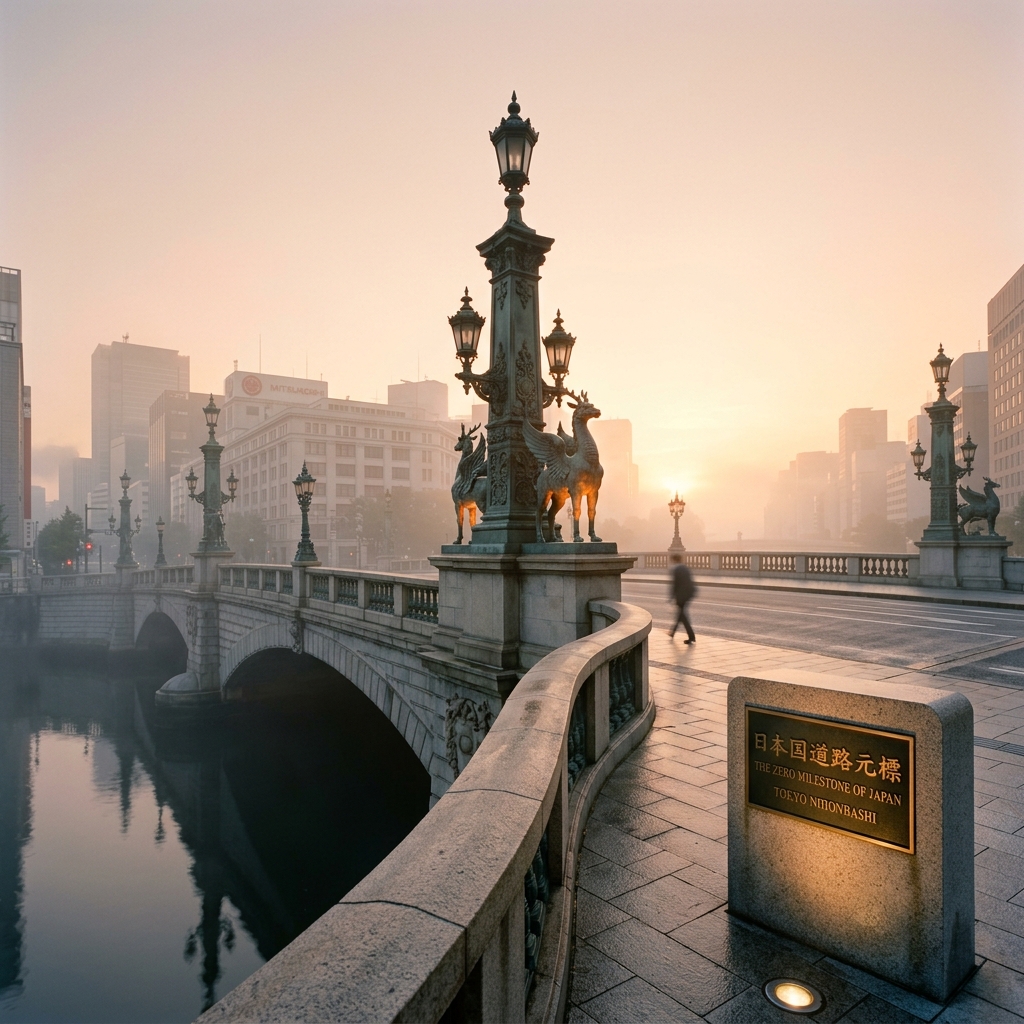
I have recently relocated to Nihonbashi (日本橋), which will serve as my new home and the central hub for my activities.
This essay opens the Nihonbashi Series — a four-part exploration of the district through distinct lenses. Here we examine the symbolic and historical gravity of Japan’s kilometre zero. The companion posts offer a street-level walking guide, a retail-heritage study of COREDO, and an investment-grade pipeline analysis.
For me, Nihonbashi is not merely a famous local landmark. I want to highlight the profound meaning that Nihonbashi holds. It is an incredibly important and special place that embodies the symbolism of being the Starting Point of Everything and the Origin.
1. The Kilometre Zero: Where All Roads Begin
Just as it has historically been the point from which all roads in Japan begin (the ‘Kilometre Zero’ monument), it is also the first departure point for the magnificent journey of the famous Ukiyo-e masterpiece, ‘The Fifty-Three Stations of the Tōkaidō’.
In the Edo period, the five great highways — the Tōkaidō, Nakasendō, Nikkō Kaidō, Ōshū Kaidō, and Kōshū Kaidō — radiated from Nihonbashi toward Kyoto and other regions. The bridge monument has remained the symbolic kilometre zero for Japan’s road network ever since, and today the bronze marker is still embedded at the bridge’s center under the Metropolitan Expressway overhead. According to the Ministry of Land, Infrastructure, Transport and Tourism (MLIT), all national route distances in Japan are still measured from this single point.
This is not merely a geographic curiosity. In a country built on the principle that spatial orientation radiates from a sacred center — a concept deeply woven into Shinto shrine placement and imperial city planning — Nihonbashi’s role as the literal zero point carries cultural weight that few urban districts anywhere in the world can claim.
2. 400 Years of Commercial DNA: From Echigoya to Mitsui
Nihonbashi’s commercial identity is inseparable from the Mitsui Group’s origin story. In 1673, Mitsui Takatoshi opened Echigoya (越後屋) — a revolutionary dry-goods store that introduced fixed pricing and cash-on-delivery, upending the haggle-based retail culture of Edo-period Japan. Echigoya would eventually become Mitsukoshi, Japan’s first modern department store and still a landmark at the Nihonbashi 1-chōme intersection today.
This 350-year continuity between a single merchant family and a single district is exceptionally rare in global urbanism. It means the commercial trust capital — the accumulated goodwill, supplier networks, and consumer expectations — embedded in this neighborhood is not a decade-old brand play but a multi-century inheritance.
For investors, this heritage density translates into measurable advantages:
- Foot traffic stability: Nihonbashi attracts both heritage tourists and daily office workers, creating dual demand layers that buffer against cyclical downturns.
- Tenant quality: The district commands premium tenants who value address prestige, reducing vacancy risk and supporting rental floors.
- Redevelopment consensus: Unlike areas where landowner fragmentation stalls projects for decades, Mitsui’s concentrated ownership enables cohesive, district-wide planning.
3. The ¥1-Trillion Redevelopment Wave
Today, Nihonbashi does not linger only in the past. This area is the core crucible for mega-scale private redevelopment spearheaded by giant developers such as Mitsui Fudosan, Mitsubishi Estate, and Mori Building. Their philosophy no longer stops at erecting dense concrete skyscrapers. Instead, they elevate the fundamental added value of the local real estate to an entirely new dimension by creating “user-centric open spaces” — wide pedestrian walkways, healing green parks, and areas where commerce and culture naturally intersect.
Key Projects as of 2026
| Project | Developer | Scale | Status |
|---|---|---|---|
| Nihonbashi 1-chōme Central District | Mitsui Fudosan | 52F tower, 284m, Waldorf Astoria Tokyo | Completed early 2026 |
| COREDO Muromachi series (1–3 + Terrace) | Mitsui Fudosan | Retail + office mixed-use, 4 buildings | Operational |
| Nihonbashi Expressway Underground Project | Tokyo Metropolitan Gov. | ¥320B, 1.2km of elevated expressway removal | In progress, target 2035 |
| Yaesu-Nihonbashi-Kyobashi Urban Renaissance | Multiple | Over 20 sites designated for renewal | 2025–2040 phased |
According to Mitsui Fudosan’s official Nihonbashi development page, the company’s cumulative investment in the Nihonbashi district has exceeded ¥500 billion over the past two decades, with ongoing projects expected to bring the total beyond the ¥1 trillion mark by 2035.
The single most transformative project is the Metropolitan Expressway underground relocation. When complete, the Nihonbashi Bridge — currently shadowed by the 1960s-era elevated highway — will be exposed to open sky for the first time in over 60 years. The symbolic impact of “liberating” Japan’s kilometre zero from concrete overhead cannot be overstated. Preliminary studies suggest the removal will increase pedestrian traffic by 30–40% and create approximately 1.2 hectares of new waterfront green space along the Nihonbashi River.
4. Where Tradition and Future Coexist
In this context, Nihonbashi — where centuries-old traditional shops, cutting-edge commercial buildings, and lush greenery face one another — is a space where long-standing tradition and the dynamic future perfectly coexist.
Walking through the district today, you experience this duality at every turn:
- Ninben (にんべん), founded in 1699, still sells hand-shaved katsuobushi (bonito flakes) on the ground floor of COREDO Muromachi, steps away from a Michelin-starred French restaurant.
- Haibara (榛原), a traditional Japanese paper shop established in 1806, operates from a modern storefront while maintaining artisan techniques passed down for over 200 years.
- The Bank of Japan headquarters (built 1896, designed by Tatsuno Kingo in neo-baroque style) sits within walking distance of sleek fintech startups in the reborn Kabutocho district.
This is not manufactured nostalgia. It is the natural result of a district that has continuously reinvented itself while retaining the institutions that define its identity.
5. The Gravity of the Zero Point
When people trace back through all mechanisms and history to grasp the truth, this is the final zero point (0) they reach, the place situated at the very center. I believe this is exactly where any new endeavor starts, and where the purest origin of all events and ideas resides. That is the true gravity that Nihonbashi possesses.
The district’s per-tsubo land price in prime areas now exceeds ¥50 million (approximately $330,000 per square meter), making it one of the most expensive commercial corridors in Asia outside of Hong Kong and Singapore. Yet unlike those cities, Nihonbashi’s valuation is underpinned not by scarcity alone but by the density of institutional history, government infrastructure investment, and private-sector commitment that few districts can replicate.
For the investor, Nihonbashi represents something more subtle than a high-yield opportunity. It is a store of trust — a place where capital preservation and generational wealth transfer have been practiced continuously for four centuries. The yields may not be the highest in Tokyo, but the risk-adjusted stability is unmatched.
6. A New Beginning from the Origin
Through this relocation, it is my earnest desire that this space becomes the ‘True Center of Japan’ for me, and for the countless initiatives we will create. From here in Nihonbashi, the origin of all things, please look forward to the new beginnings we will chart moving forward.
Today, Chuo City’s multilingual guides to culture and urban regeneration are part of how that symbolism is translated into contemporary competitiveness — linking the bridge, shopping arcades, and station areas into a coherent pedestrian experience. The Chuo City multilingual portal and the Japan National Tourism Organization overview of Tokyo and Nihonbashi are useful starting points to see how official sources frame the district.
Further reading from Nihonbashi
- Nihonbashi Hamacho Walking Guide
- Nihonbashi Redevelopment Roadmap: Three Axes to Read Mitsui-Led Follow-On Projects
- What COREDO Nihonbashi and Muromachi Connect
Walking Action: Session Summary & Check
- History: Visit the former site of Echigoya (now Mitsukoshi) to feel the energy where Japanese retail and capitalism were born.
- Symbol: Reflect on the meaning of prosperity and protection embodied by the winged lions (Kirin) of Nihonbashi Bridge.
- Change: Experience the unique atmosphere where department store tradition meets the financial innovation of Kabutocho.